London Christmas Lights 2026: Dates, Switch-On Times & Where to See Them
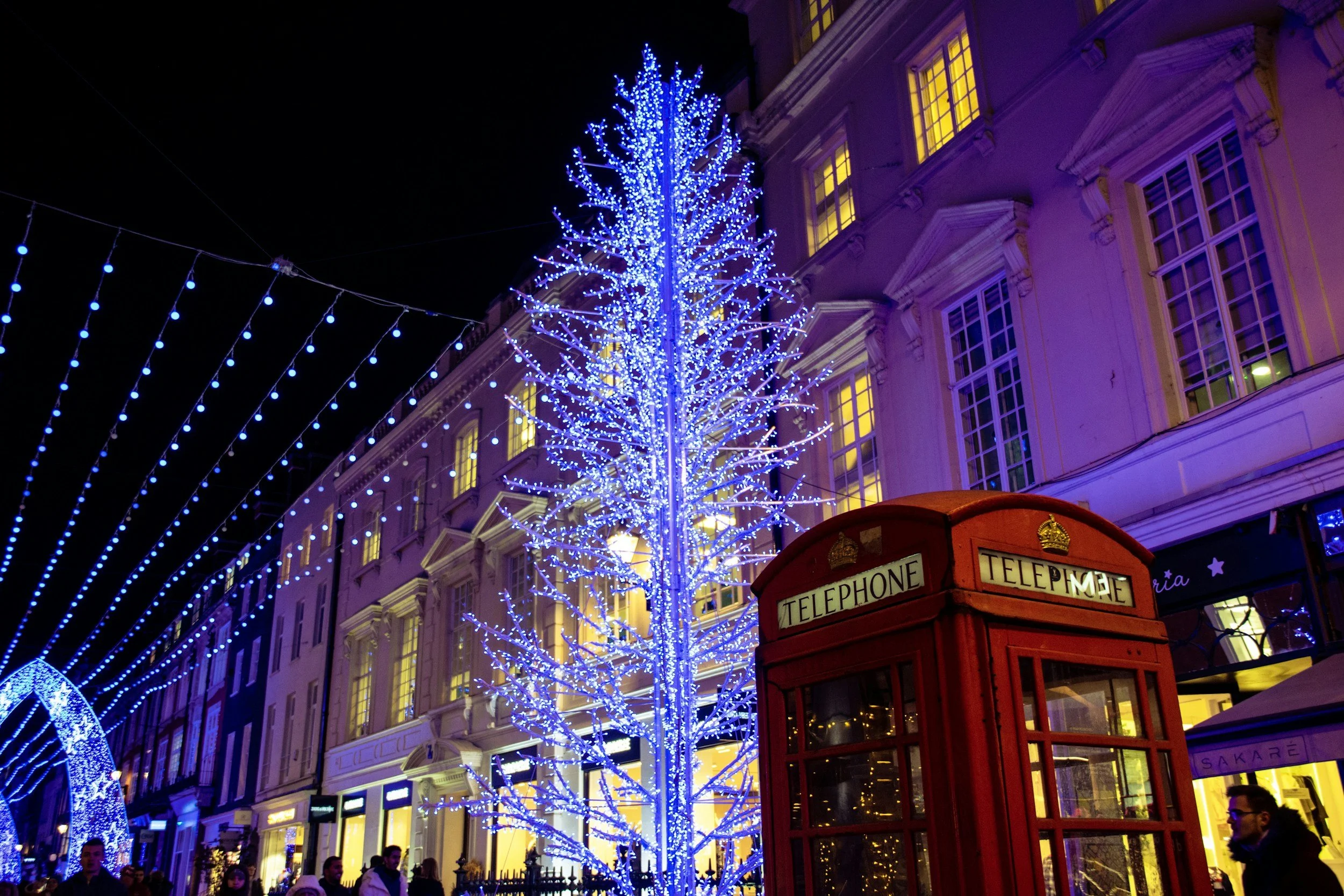
There is a particular moment when London starts to feel different.
The evenings get darker earlier, the shop windows become more extravagant, and suddenly you notice Christmas trees appearing where there were none a few days before. Then, almost overnight, the streets begin to glow.
But if you are in London during October, you might already be wondering: why does Christmas seem to arrive so early?
The answer is slightly more complicated than you might think.
Christmas decorations and installations can start appearing in London during October, but that does not mean the city's major Christmas lights are being officially switched on in October. The big street-light switch-ons generally happen in November, with different parts of London choosing different dates.
And there is no single "London Christmas lights switch-on". Carnaby Street has its own event. Regent Street has its own. Covent Garden has its own. Other neighbourhoods and shopping districts have their own schedules too.
For 2026, some dates are already confirmed, while others have not yet been officially announced.
So, if you're planning to see London's Christmas lights this year, here's what you actually need to know including the history behind some of the city's most famous displays, why the designs change, how old some of them are and when you should go.
When do London's Christmas lights actually switch on?
The easiest answer is: mostly November.
Some Christmas decorations can start appearing during October, particularly around shops, department stores and major attractions. Businesses need time to install large structures, test electrical systems and prepare their Christmas campaigns.
But the major public street displays are generally switched on later.
Carnaby Street's 4 November date has been officially announced by Shaftesbury Capital, while Regent Street has confirmed its 5 November switch-on. Covent Garden has also confirmed 12 November.
One important point if you're planning a Christmas trip: don't automatically trust a date copied from a previous year.
As of October 2026, Oxford Street had announced its theme but had not yet published its 2026 switch-on date. Some other areas were also still waiting to confirm their dates. Current round-ups specifically warn that not every 2026 date has been announced yet.
That is why it is better to have three confirmed dates than a list of twenty dates where half are guesses.
So why do you see Christmas decorations in October?
This is where the confusion comes from.
There is a difference between putting Christmas decorations up and switching the Christmas lights on.
Large London shopping districts need weeks to prepare their Christmas installations. Some of the displays are enormous engineering projects involving thousands of individual lights, cables, structures and suspended decorations.
Retailers also have their own Christmas campaigns to consider.
Department stores, restaurants, hotels and shops don't necessarily wait until the official street-light switch-on. Their Christmas windows and interiors can appear considerably earlier.
And there is another reason: Christmas is extremely important commercially.
For retailers, November and December are some of the biggest shopping weeks of the year. Creating a festive atmosphere early gives shoppers a reason to visit, browse and spend time in the area.
So if you're walking around London in October and suddenly spot a Christmas tree or a shop covered in decorations, it doesn't mean London has decided to celebrate Christmas three months early.
It means the preparation has started.
The actual street-light season comes later.
London's Christmas lights are not one giant display
This is one of the most important things to understand.
When people search for "London Christmas lights", it sounds as though the entire city has one organised lighting programme.
It doesn't.
Different streets and districts have different organisers, landlords, business groups or improvement districts. They design, fund and operate their own displays.
City Hall has previously explained that London's Christmas lights are organised by local business improvement districts or landlords, who are responsible for details such as switch-on and switch-off dates.
That is why you can have Carnaby Street switching on its lights on Wednesday, Regent Street doing it the following evening and Covent Garden waiting another week.
London essentially builds its Christmas atmosphere district by district.
And honestly, that's part of the fun.
Regent Street: one of London's oldest Christmas-light traditions
If there is one London Christmas light display with serious history, it is Regent Street.
The first regular Regent Street Christmas lights date back to 1954. That means the tradition reaches its 72nd anniversary in 2026. Regent Street itself describes 2024 as the 70th anniversary of its Christmas lights.
The original display looked very different from what you see today.
There were no enormous modern LED installations stretching across the street. The early decorations featured illuminated stars and were lit using searchlights a reminder of how different London's technology was in the post-war period.
Today's display is much more recognisable.
The famous Spirit of Christmas angels returned in 2026, with new sparkling details added to the installation. The 2026 display consists of 30 illuminated figures and around 300,000 LED lights, extending across Regent Street, Jermyn Street and St James's Market, with additional displays nearby.
The current Spirit of Christmas design dates from 2016, so while the wider Regent Street tradition is more than seven decades old, the angels you recognise today are much newer.
That distinction is important.
The tradition is old.
The design isn't.
Oxford Street: a Christmas tradition dating back to 1959
Oxford Street followed Regent Street a few years later.
The first full Oxford Street Christmas decorations appeared in 1959. UCL's Survey of London records that year as the first time Oxford Street was decorated from one end to the other, with Christmas trees, tinsel and coloured bulbs used along the street.
So in 2026, Oxford Street's Christmas-light tradition is around 67 years old.
But it hasn't been completely uninterrupted.
Economic pressures meant that Christmas-light displays disappeared from some major London streets during the 1970s. Regent Street, for example, had no lights from 1972 to 1977 because funding wasn't available during the recession.
Oxford Street also had interruptions during its history.
This is something worth remembering when someone says a London Christmas light display has been running "every year" for decades. Sometimes the tradition is continuous, while the actual installation has changed or there have been years without a display.
And what is happening on Oxford Street in 2026?
This year is particularly interesting because Oxford Street's Christmas lights are getting a Harry Potter theme.
More than 5,000 white stars are expected to return above the street, joined by new illuminated designs inspired by the wizarding world. The theme ties into the opening of the world's largest Harry Potter store on Oxford Street and the upcoming HBO series.
However, as of 13 October 2026, the official switch-on date had not yet been announced.
So if you see a website confidently giving you a specific Oxford Street switch-on date, check when that information was published.
For now, the theme is confirmed.
The exact switch-on date is not.
Does London use the same Christmas lights every year?
Sometimes yes.
Sometimes no.
And this is one of the most interesting things about London's Christmas displays.
Some places have developed an instantly recognisable identity and reuse major structural elements from one year to the next. Others deliberately change their theme every Christmas.
Regent Street is a good example of a long-running visual identity. The Spirit of Christmas angels have been used since 2016, although details can be refreshed and new elements added.
Carnaby Street, on the other hand, is much more experimental.
For 2026, Carnaby has announced Press Play on Christmas, a display inspired by the colour, creativity and nostalgia of a British 1990s Christmas.
The structures can be reused while the overall presentation and theme changes.
And that makes sense.
Imagine rebuilding an enormous Christmas installation completely from scratch every single year.
It would be expensive, wasteful and unnecessary.
Instead, designers can reuse structural elements, change lighting arrangements, add new features and give the installation a completely different personality.
That is why returning to the same street every Christmas doesn't necessarily mean seeing exactly the same thing.
Carnaby Street: Christmas with a different personality
Carnaby Street has become one of the best places to see a Christmas display that doesn't look like every other Christmas display in London.
The area has a long association with fashion, music and London's counterculture, particularly during the 1960s.
Its Christmas decorations often reflect that more playful identity rather than simply covering the street in traditional red and gold.
In 2026, the theme is Press Play on Christmas, inspired by 1990s Britain. The new-look display was announced in October and will be switched on on 4 November.
The organisers have also highlighted the reuse of lighting structures from previous years, helping reduce the need to create an entirely new installation every season.
This is one of the reasons Carnaby is worth visiting even if you've seen London's Christmas lights before.
The point isn't simply to see lights.
It's to see what that particular part of London has decided Christmas should look like this year.
Covent Garden: when Christmas becomes theatre
Covent Garden does things differently again.
Rather than relying only on lights suspended above a shopping street, the entire area becomes part of the Christmas experience.
For 2026, Covent Garden's festive programme is called The Theatre of Christmas, returning from its 12 November switch-on.
The Market Building is decorated with oversized gold bells, baubles and mirror balls, while the West Piazza features a British-grown Christmas tree.
The display includes more than 300,000 lights across the neighbourhood.
The official switch-on takes place on Thursday 12 November 2026, with live festive performances and a countdown to the button-push moment.
This is one of those places where you don't really need to plan a complicated itinerary.
Walk around the Piazza.
Look inside the Market Building.
Explore the surrounding streets.
Then continue towards Leicester Square, Soho or Regent Street.
You can turn an evening of Christmas lights into a proper London walk.
Why do the lights change every year?
There are several reasons.
First, people want something new.
If the same installation appeared unchanged every Christmas for twenty years, it would eventually stop feeling special.
Second, London districts use their Christmas displays as part of their identity.
Carnaby wants something creative.
Regent Street wants something elegant and recognisable.
Covent Garden leans into theatre.
Oxford Street uses its enormous shopping environment to create a large-scale spectacle.
Third, new designs give London something to talk about.
Every autumn, newspapers, social media accounts and Londoners themselves start asking:
What does this year's display look like?
That anticipation has become part of the Christmas tradition.
And finally, technology keeps changing.
LED lighting makes it possible to create brighter and more elaborate displays while using less energy than older lighting technologies. Oxford Street's current display, for example, uses LED lighting designed to use less energy than traditional lights.
Are London's Christmas lights sustainable?
This is increasingly important.
Modern displays are not simply about adding more and more bulbs.
Energy use, materials, transportation, storage and reuse all matter.
One of the simplest ways to reduce waste is to reuse structures rather than manufacture completely new installations every year.
Carnaby Street has highlighted its reuse of lighting structures, while modern displays increasingly use LED technology.
That doesn't mean Christmas lights have zero environmental impact.
They still require electricity, materials, installation and maintenance.
But the move towards LEDs and reusable structures is a significant change from the old days of simply putting up increasingly elaborate displays without much thought about their environmental footprint.
How long do London's Christmas lights stay up?
Usually, the lights remain in place well beyond Christmas Day.
That's another reason why you don't need to rush to London on the exact switch-on night.
Regent Street's 2026 display, for example, is scheduled to remain illuminated until 5 January 2027, with the lights operating daily from 3pm to midnight.
Visit London notes that Christmas lights and decorations across London commonly remain until around 6 January, although the exact dates vary by area.
So if you're visiting in December, you haven't missed anything.
And if you're visiting between Christmas and New Year, you may actually find it easier to enjoy the displays without the intensity of the early switch-on crowds.
Do you need to pay to see London's Christmas street lights?
For the major street displays, no.
You can walk underneath the Christmas lights on streets such as Regent Street, Carnaby Street, Oxford Street and around Covent Garden without buying a ticket.
What you may have to pay for is everything around them.
Christmas light trails at attractions, special events, skating rinks, festive experiences and some organised tours are separate activities.
That distinction is useful when planning a Christmas trip.
You can have a brilliant evening seeing London's major street lights without spending anything on tickets.
When is the best time to see the lights?
You don't necessarily need to attend a switch-on event.
In fact, if your main goal is photography or simply enjoying the lights, I would usually recommend going after the switch-on night.
The switch-on events can be extremely busy because they combine the lighting ceremony with entertainment, performances and crowds.
A normal weekday evening can be much more enjoyable.
Start around 4pm, when November's early darkness begins to arrive, and walk through the West End as the lights become more noticeable.
A simple route could take you from:
Oxford Street → Regent Street → Carnaby Street → Soho → Leicester Square → Covent Garden
You can also extend the walk towards St James's and Piccadilly.
The exact route will depend on which displays have been switched on by the date of your visit.
So, do London's Christmas lights start in October?
The preparation does. The major switch-ons generally don't.
That's probably the simplest way to explain it.
October is when London starts getting ready.
You may see decorations being installed, Christmas shops opening and festive campaigns appearing across the city.
But the major street-light switch-ons happen predominantly in November.
For 2026, three major dates are already confirmed:
Carnaby Street - 4 November
Regent Street - 5 November
Covent Garden - 12 November
Oxford Street's 2026 Harry Potter-inspired display is confirmed, but its official switch-on date had still not been announced as of 13 October.
And that's actually the best thing about London's Christmas lights.
They don't all appear at once.
The city slowly changes.
One street lights up.
Then another.
Then another.
And before you realise it, London has gone from autumn to Christmas.
London's Christmas lights are more than just decorations
It's easy to look at a Christmas light display and see nothing more than thousands of LEDs hanging above a road.
But London's displays have become part of the city's history.
Regent Street's tradition goes back to 1954.
Oxford Street followed in 1959.
The designs have changed.
The technology has changed.
The businesses behind them have changed.
There have even been periods when economic conditions meant some displays disappeared.
Yet the tradition keeps returning.
That's why seeing the lights in London feels different from simply putting up decorations at home.
They belong to the streets.
They become part of people's memories — a first Christmas in London, a winter shopping trip, a date, a family evening, a photograph taken under the Regent Street angels, or simply that moment when you realise the year is nearly over.
And if you're planning a Christmas trip to London in 2026, you don't need to wait until December.
From early November onwards, the city will already be beginning its transformation.
Just remember: October is preparation. November is when the lights really start coming on.
Planning your next London day out? Discover more neighbourhood guides, hidden gems, food spots and things to do on LondonYaar.com.
Follow @rohan.londonyaar for more London places, stories and things worth knowing before you visit.