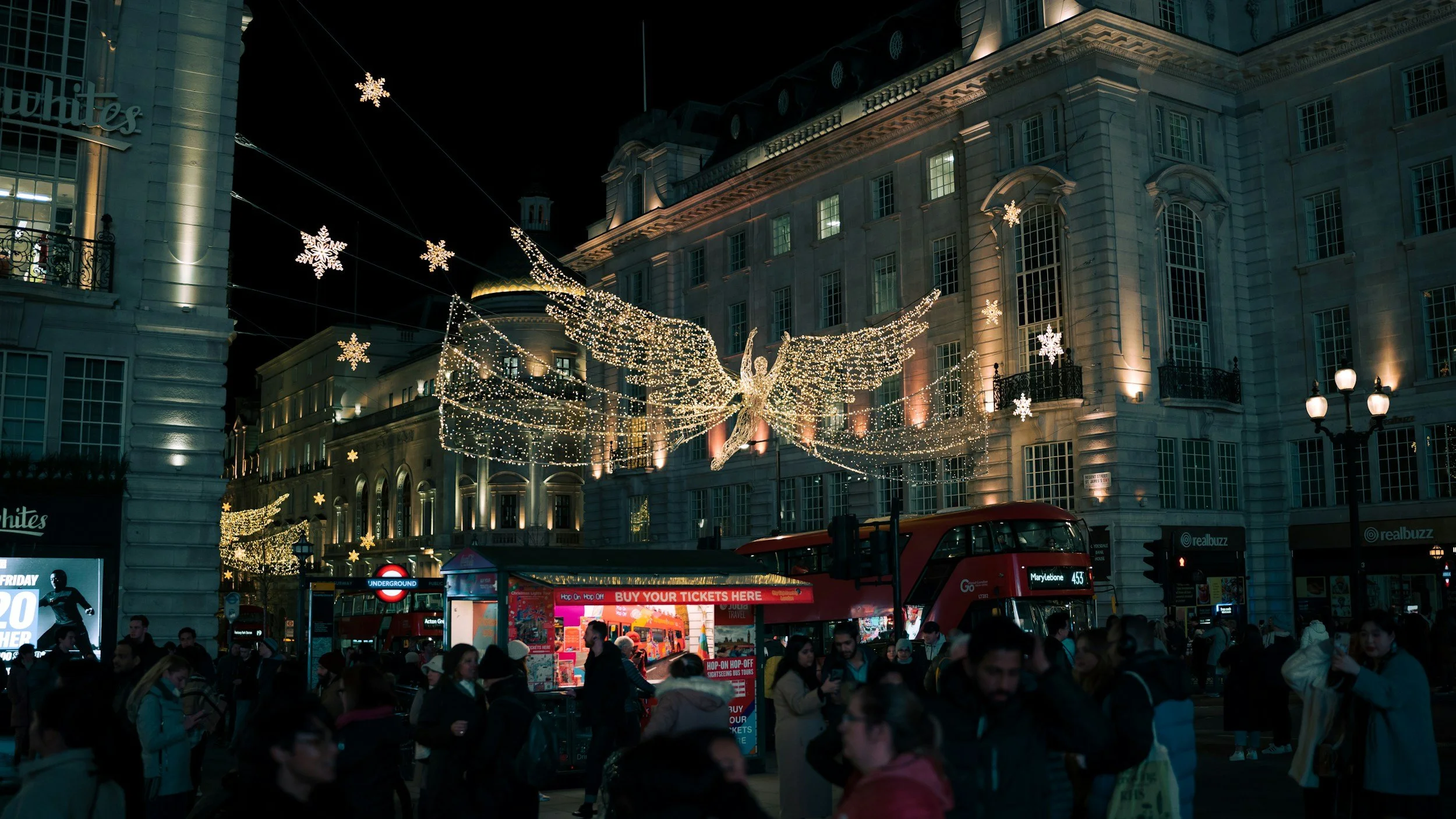
Every year, London seems to change almost overnight. One day you're walking through the West End surrounded by ordinary shopfronts, traffic and commuters. A few weeks later, the same streets are glowing with enormous Christmas angels, sparkling trees, colourful decorations and festive displays hanging above the roads.
Regent Street looks like something from a Christmas film. Covent Garden is filled with giant baubles and golden decorations. Carnaby Street introduces a completely different creative theme, while Oxford Street becomes one enormous festive shopping destination.
It's easy to enjoy the finished result, take a few photographs and carry on with your evening. But have you ever stopped to think about how much work goes into making all of this happen?
Those decorations don't simply appear overnight. Behind London's Christmas transformation are months of planning, designers, electricians, engineers, installation crews, specialist equipment, transport arrangements, safety checks and plenty of overnight work.
And because London is still a busy working city, much of the installation has to happen while most people are asleep.
So, how much work actually goes into decorating London for Christmas? Let's take a look behind the scenes.
1. The planning starts months before Christmas
Although the Christmas lights usually become visible in November, the preparation begins much earlier.
Large displays need to be designed, approved, manufactured or refurbished, transported and installed. Organisers also need to coordinate with local authorities, property owners, businesses and traffic management teams.
The planning can be particularly complicated in busy areas such as Oxford Street, Regent Street and Covent Garden. These aren't quiet streets that can simply be closed for several days while decorations are put up. They are major shopping and visitor destinations, with deliveries, public transport, pedestrians and businesses that need to keep operating.
Westminster City Council publishes an indicative timetable for applications involving Christmas street decorations. Its timetable includes an initial meeting on 30 July, a period for developing ideas and plans, and an application submission milestone on 23 August. Further technical and highway submissions follow in September and October, with installation scheduled from 1 November.
This is an indicative process rather than a universal deadline for every Christmas display in London. Different locations and organisers have their own arrangements.
Nevertheless, it gives you an idea of how early the preparation begins. While most people are enjoying summer, organisers are already thinking about Christmas.
2. Designing the displays is a job in itself
One of the reasons London's Christmas decorations feel different from one neighbourhood to another is that they aren't all designed around the same idea.
Some streets prefer traditional Christmas imagery, while others use contemporary artwork, unusual colour combinations or themes connected to the area's identity.
Take Regent Street, for example. Its famous angel-shaped decorations are part of the area's long-running festive identity. Carnaby Street tends to take a more playful and creative approach, while Covent Garden is known for its enormous Christmas tree, hanging decorations and elaborate festive installations.
Designers have to think about more than how a display looks in a photograph. They need to consider how it appears from different points along a street, how it looks during daylight, how it works after dark and how it fits around the surrounding architecture.
There are also practical questions. How heavy is the installation? How will it be attached? Can it withstand strong winds? Will it obstruct signs, traffic signals or essential street equipment?
A beautiful Christmas decoration might begin as a drawing or digital design, but turning that idea into something that can safely hang above a busy London street takes considerable technical work.
3. Installation often happens while London sleeps
This is probably the part of the process that surprises people most.
Much of London's Christmas lighting installation takes place overnight, when streets are quieter and traffic restrictions are easier to arrange.
The Heart of London Business Alliance published a detailed 2026 installation schedule for parts of the West End. It lists several overnight operations, with road closures generally taking place between 9pm or 10pm and 6am.
For example, the installation between Waterloo Place and Piccadilly Circus was scheduled for 11–14 October, from 10pm to 6am. Work on the Regent Street St James's section was scheduled for 27–29 October, also overnight, with another installation night listed for 24 November.
Other sections, including Garrick Street and William IV Street, also had overnight installation schedules.
Think about what that means for the people doing the work. While restaurants are closing, shops are shutting their doors and commuters are heading home, installation teams are arriving with equipment, vehicles and decorations.
They need to work within restricted time windows, complete their assigned sections and leave the streets safe for the following morning.
It is a very different kind of Christmas preparation from putting a tree up in your living room.
4. Specialist equipment and skilled crews are essential
Many of London's decorations are far too large or too high to install using ordinary ladders.
Installation teams may need specialist lifting equipment, access platforms, cranes, safety harnesses and traffic management vehicles. The equipment depends on the location and the size of the display.
Working above a busy street also requires careful attention to safety. Installers must secure the decorations properly, inspect attachment points and make sure equipment is suitable for the weight and conditions involved.
Regent Street offers a particularly interesting example. A 2026 behind-the-scenes report in The Times described a team of 25 riggers installing the street's Christmas angel structures over nearly a month of night shifts.
The report also explained the engineering involved in modelling wind and snow loads, as well as testing how the display appears both in person and through smartphone cameras.
The current Regent Street display features 45 large angel figures, with more than 300,000 micro-LEDs illuminating the installation at night. Its aluminium frameworks are reused, with the components stored locally between festive seasons.
It gives you a sense of how much specialist work can sit behind something that visitors might simply describe as a beautiful Christmas light display.
And it isn't just about putting the decorations up. They must remain secure and presentable throughout the festive season, even when London's weather is far from predictable.
5. The cost can be much higher than people expect
There isn't one single figure for the cost of decorating London for Christmas.
Different streets, business associations, councils, shopping destinations and private venues organise their own displays. Some decorations are reused, others are redesigned, and the budgets can cover very different things.
However, publicly available figures give us a useful idea of the expense involved.
London's Trafalgar Square Christmas tree is a particularly interesting example. The Greater London Authority publishes information about the costs associated with its installation.
According to its November 2024 Freedom of Information response, the cost of installing the Trafalgar Square tree was:
2022: £39,702.03
2023: £29,693.16
These are documented installation costs relating to the Trafalgar Square tree. They are not the total cost of decorating Trafalgar Square, nor the total cost of London's Christmas displays.
There is another interesting figure from Westminster City Council. In June 2026, the council approved a procurement strategy for a Christmas tree services contract with an estimated value of £432,000.
That is an estimated contract value for the relevant services, not a figure that should be described as the annual cost of decorating the West End or the entire capital.
The important point is that even a single major festive installation can involve a substantial budget. Once you add dozens of streets, shopping areas, public spaces and individual venues, the overall operation becomes much larger.
6. Even the famous Trafalgar Square Christmas tree has a journey of its own
One of London's most recognisable Christmas traditions is the enormous tree in Trafalgar Square.
But unlike a tree purchased from a local garden centre, this one travels a considerable distance before it reaches the capital.
The tree is a gift from Norway to the people of London, a tradition that dates back to 1947. It is usually a Norwegian spruce, often more than 20 metres tall and around 50 to 60 years old.
According to the Greater London Authority, the tree is carefully selected from the forests surrounding Oslo, sometimes several months or even years in advance. It is felled in November, brought to the UK by sea and then transported by lorry to Trafalgar Square.
Once it arrives, a specialist rigging team uses a hydraulic crane to erect it.
The tree is decorated in a traditional Norwegian style, with vertical strings of energy-efficient lights.
And the work doesn't end after Christmas. Once the festive period is over, the tree is taken down, chipped and composted to make mulch.
It's quite remarkable to think that one of London's most photographed Christmas decorations begins its journey in a Norwegian forest before becoming part of the capital's festive celebrations.
7. Decorations need to be maintained throughout the season
Getting the decorations installed is only half the job.
Once the lights are switched on, organisers need to make sure they remain safe and working throughout the festive period.
Outdoor installations face rain, wind, cold temperatures and the general wear and tear of being exposed to the elements. A damaged connection or loose component can become a problem if it isn't dealt with.
Large public displays also need to be monitored so that any faults can be identified and repaired.
This is particularly important in places that attract enormous crowds. A Christmas display above a busy shopping street needs to remain secure, not just look attractive.
Maintenance arrangements vary between organisers, so there isn't one single inspection schedule for all of London's Christmas lights. But it is another reason the work continues long after the switch-on celebrations have finished.
8. Taking everything down is another major operation
Once Christmas is over, the work doesn't simply stop.
Some decorations remain in place until early January, while others are removed according to their own schedules. The process often involves overnight road closures, specialist lifting equipment and teams working through the streets again.
The Heart of London Business Alliance's 2026 operational schedule includes removal dates stretching into January. For example, the Waterloo Place to Piccadilly Circus decorations were scheduled for removal on 20–21 January, while parts of Regent Street St James's were scheduled for removal on 8–9 January.
The decorations need to be lowered carefully, checked, packed and transported away. Any equipment or fittings attached to buildings and street infrastructure must also be removed safely.
Some installations can be reused in future years, which means they need to be stored properly. Others may require repairs, refurbishment or replacement before they can be used again.
For the teams involved, January can be just as busy as October and November.
9. London's Christmas decorations are a team effort
It is easy to think of Christmas lights as something organised by one company, but large public displays usually involve several organisations working together.
Depending on the location, the people involved can include:
Designers and creative teams: They develop the look and theme of the display.
Engineers and technical specialists: They work out how installations can be supported safely.
Electricians: They handle electrical connections, lighting systems and technical checks.
Riggers and installation crews: They put the decorations into position using specialist equipment.
Traffic management teams: They coordinate road closures, diversions and access arrangements.
Local authorities: They review permissions and relevant safety and planning requirements.
Maintenance teams: They help keep the installations in good condition throughout the season.
There are also the businesses, property owners and local organisations that help fund, coordinate or host festive displays.
It is a lot of people working behind the scenes to create something that visitors can enjoy without buying a ticket.
10. The work continues across the whole city
When people think about London's Christmas decorations, they often picture Oxford Street and Regent Street. But festive displays appear in many other parts of the capital too.
Covent Garden has its famous hanging decorations, giant Christmas tree and elaborate festive setting. Carnaby Street takes a more creative approach, while Battersea Power Station has its own large-scale festive installations.
Chelsea, Marylebone, King's Cross, Leicester Square and many other neighbourhoods also have their own seasonal decorations.
The designs, scale and installation arrangements differ from place to place, but each display adds something to London's overall Christmas atmosphere.
And that's what makes the transformation so impressive. It isn't one enormous decoration project happening in one location. It's a collection of different projects, each with its own creative ideas, teams, schedules and logistics.
So, how much work goes into decorating London for Christmas?
Quite a lot more than most visitors probably realise.
Months of planning can go into a display that people might only stop to admire for a few minutes. Installation crews work overnight, engineers consider wind and snow loads, electricians deal with lighting systems, and local authorities coordinate permissions and road access.
Then there is the cost of transporting, installing, maintaining, removing and storing the decorations.
And all of this happens while London continues to operate as one of the busiest cities in the world.
The next time you're walking beneath the Christmas angels on Regent Street, admiring the decorations in Covent Garden or taking photographs beneath the lights on Carnaby Street, spare a thought for the people who made it happen.
Because behind every sparkling Christmas street is a lot of hard work, careful planning and people who spend their nights making London look magical for everyone else.
Planning your next London day out? Discover more neighbourhood guides, hidden gems, food spots and things to do on LondonYaar.com.
Follow @rohan.londonyaar for more London places, stories and things worth knowing before you visit.