Why Is Notting Hill Carnival Celebrated? The History, Meaning, Origins & How to Experience It
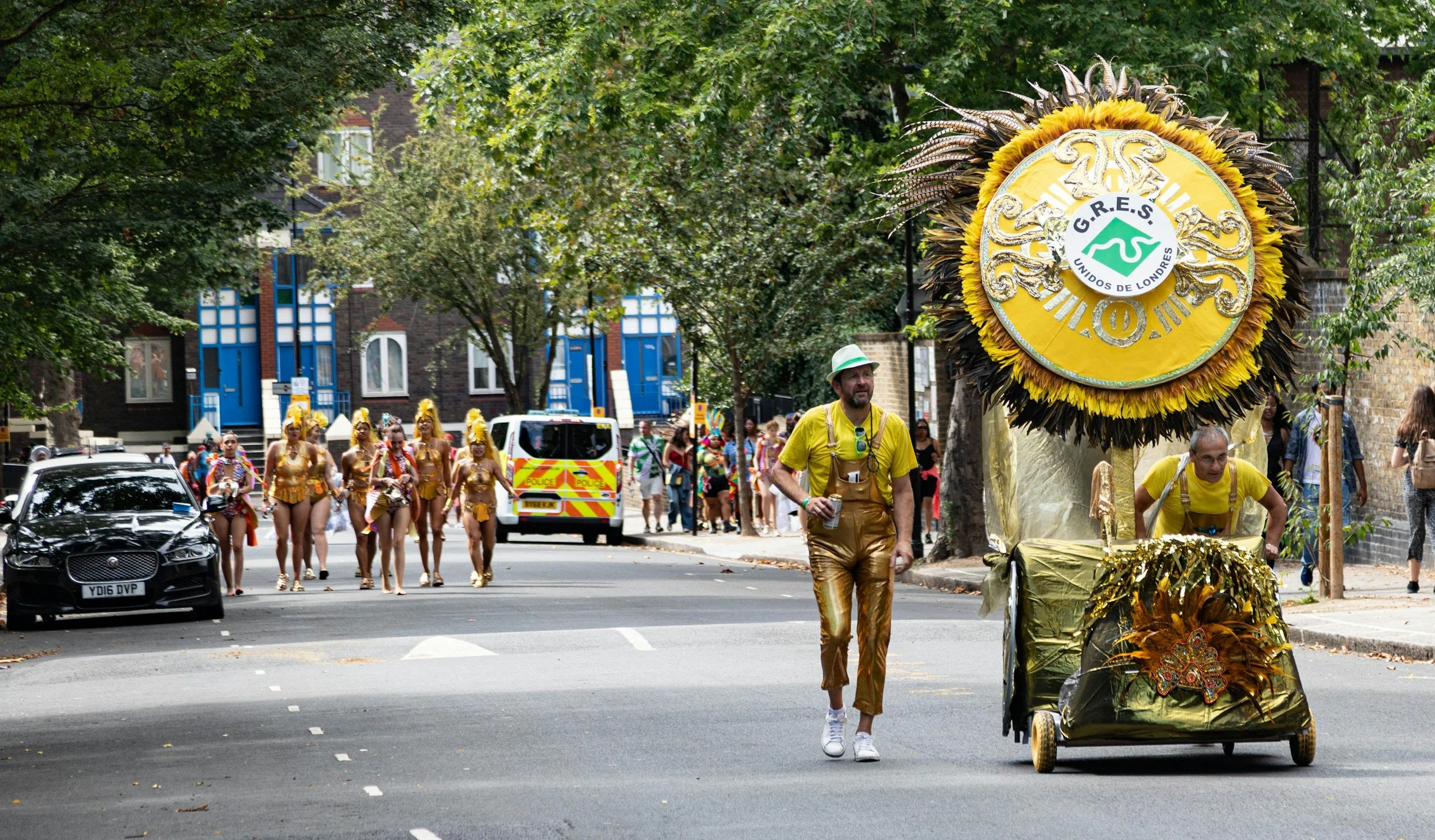
There is a moment at Notting Hill Carnival when you stop thinking about London as you normally know it.
The streets are packed.
Steelpan is playing.
Soca is coming from one direction while reggae or another sound system is booming from somewhere else.
People are wearing enormous, colourful costumes.
Children are dancing.
Food stalls are filling the streets with the smell of jerk chicken, roti and Caribbean spices.
And thousands of people are moving through Notting Hill together.
It looks like one enormous party.
But Notting Hill Carnival is much more than a party.
Behind the costumes, music and dancing is a history of migration, racism, community, resistance, Caribbean culture and the determination to bring people together.
In fact, the official Carnival organisation describes its beginnings as a response to a neighbourhood affected by racial tension, poor housing and social division.
So why is Notting Hill Carnival celebrated?
When did it begin?
Who started it?
Why are Caribbean culture, steelpan, calypso, soca and sound systems so important?
And what should you wear if you're going?
Here's the story behind one of London's most famous celebrations.
What is Notting Hill Carnival?
Notting Hill Carnival is an annual Caribbean and community-led street festival in west London.
It takes place across the Notting Hill, Ladbroke Grove and surrounding areas during the August Bank Holiday weekend.
The modern Carnival features:
Mas bands and elaborate costumes
Steelpan bands
Calypso
Soca
Reggae
Sound systems
Brazilian bands
Dancing
Street food
Live performances
Parades
Community events
It has grown enormously since its beginnings in the 1960s.
Today, the official organisation describes it as Europe's largest cultural event and the world's second-largest carnival.
But its size can sometimes hide the reason it exists.
Carnival was not originally created as a giant tourist attraction.
It grew from a local community's desire to come together.
Why is Notting Hill Carnival celebrated?
At its heart, Notting Hill Carnival is about community, Caribbean culture, identity, creativity and togetherness.
But there isn't one single reason why it exists.
Its history developed through several important events and influences.
The neighbourhood of Notting Hill experienced serious racial tensions during the 1950s.
Large numbers of Caribbean migrants had arrived in Britain, particularly after the Second World War, and many faced racism, discrimination, poor housing and hostility.
Tensions eventually erupted into violence during the Notting Hill race riots of 1958.
Then, in 1959, a young Antiguan man named Kelso Cochrane was murdered in a racially motivated attack in Notting Hill.
His death deeply affected the local community and became an important part of the history surrounding Carnival. The case remains unsolved.
This history matters.
Because Carnival wasn't simply about putting music on the streets.
It became a way for communities to come together in a neighbourhood that had experienced division and hostility.
The story actually starts before 1966
If you search for the year Notting Hill Carnival started, you'll usually see 1966.
And 1966 is indeed the year the first outdoor Notting Hill Carnival took place.
But the story begins earlier.
One of the most important figures was Claudia Jones, a Trinidadian journalist, activist and community organiser.
In January 1959, Jones organised an indoor Caribbean Carnival at St Pancras Town Hall.
It was broadcast by the BBC and helped bring Caribbean music, culture and Carnival traditions to a wider British audience.
The official Notting Hill Carnival history credits Jones with planting important seeds for Carnival culture in Britain.
So while 1966 marks the beginning of the outdoor Notting Hill Carnival we recognise today, Caribbean Carnival culture was already developing in London before that.
That's an important distinction.
Then came Rhaune Laslett
The next major figure in the story was Rhaune Laslett.
Laslett was a local community activist and social worker who wanted to bring people in her neighbourhood together.
Notting Hill at the time was densely populated and socially divided.
Different communities lived close to each other but didn't necessarily interact.
Laslett organised a children's street party in 1966, with the intention of bringing the neighbourhood together.
She invited Trinidadian steelpan musician Russell Henderson and his band to perform.
And then something happened that nobody could have predicted.
The steel band began moving through the streets.
People followed.
They danced.
More people came outside.
And the procession moved through Portobello Road.
That spontaneous procession is widely regarded as the beginning of the outdoor Notting Hill Carnival.
So, when did Notting Hill Carnival actually start?
The simplest answer is:
1966.
That was the year of the first outdoor festival in the streets of Notting Hill.
But if you're explaining its history properly, there are three important dates to remember:
1959 - Claudia Jones's Caribbean Carnival
Jones organised an indoor Caribbean Carnival at St Pancras Town Hall, helping establish Caribbean Carnival culture in Britain.
1966 - The first outdoor Notting Hill Carnival
Rhaune Laslett's community street event brought Russell Henderson's steel band into the streets, creating the foundation of the Carnival we know today.
1970s - Carnival becomes increasingly Caribbean in character
During the early 1970s, the event's leadership and artistic identity became increasingly centred on Caribbean culture, while political and social tensions surrounding London's Black communities also influenced its development.
So saying “Notting Hill Carnival started in 1966” is correct.
But saying “it appeared out of nowhere in 1966” would miss much of the story.
Why is Caribbean culture at the heart of it?
Notting Hill Carnival grew alongside London's Caribbean communities.
The Windrush generation and later Caribbean migrants brought music, food, traditions, religion, language and Carnival culture with them.
Those influences became part of London's identity.
You can hear it in the music.
You can see it in the costumes.
You can taste it in the food.
And you can feel it in the atmosphere.
The official Carnival history specifically describes the event as rooted in Caribbean culture, with the influence of the Windrush generation remaining strongly visible.
This is why Carnival isn't simply a colourful London festival.
It is also a celebration of Black-Caribbean British heritage.
The organisers' own 2026 Carnival Conversations programme describes Carnival as a cornerstone of Black-Caribbean British culture and focuses on its origins, legacy and continuing importance.
What does Carnival mean to the people who celebrate it?
This is difficult to reduce to one sentence.
For some people, it is about Caribbean heritage.
For others, it is about London.
For others, it is about family and community.
For some, it is about remembering the struggles that came before them.
And for many, it is simply about enjoying music, dancing, food, costumes and being together.
Those things aren't contradictory.
That's part of what makes Carnival so powerful.
The official 2026 anniversary message puts it particularly well: Carnival grew from a need within the community and from an attempt to bring divided people together.
So when people celebrate, they're not necessarily thinking about the history every second.
They're also simply enjoying the culture that came from that history.
Why are the costumes so important?
One of the first things you'll notice at Notting Hill Carnival is the costumes.
And they are spectacular.
Feathers.
Jewels.
Bright colours.
Sequins.
Wings.
Headpieces.
Huge backpacks.
Elaborate designs that can take months to create.
But these aren't simply fancy clothes designed for Instagram.
They are part of Mas, short for masquerade.
Masqueraders become part of a band and travel along the Carnival route together.
The costumes are often built around a particular theme, with different sections of a band having their own designs and colours.
The official Carnival describes participating bands as a central part of the event, with people able to join Mas bands, Brazilian bands and steel bands.
And there's an important difference between watching Carnival and being part of Carnival.
If you join a Mas band, you're not just wearing a costume.
You're participating in the parade.
How should you dress for Notting Hill Carnival?
If you're joining a Mas band, the answer is simple:
Wear the costume provided or purchased through your band and follow its guidance.
Costumes are bought directly from the participating bands, according to the official Carnival FAQ.
But what if you're simply attending as a spectator?
Then comfort matters much more than trying to look like a performer.
Wear comfortable shoes
This is probably the most important piece of advice.
You could spend hours walking, standing and dancing.
The official Carnival safety guidance specifically recommends practical clothing and says comfortable shoes are essential.
Wear something breathable
August can be warm.
Loose, breathable clothing is a sensible choice, particularly if you're going to spend several hours outside.
Bring sun protection
If the weather is hot, the organisers recommend a hat, sunscreen and plenty of water.
Be prepared for rain
It's London.
Even August isn't a guarantee of sunshine.
A lightweight waterproof layer can be useful.
Don't bring expensive jewellery
The official safety guidance specifically recommends keeping things practical and avoiding elaborate jewellery or expensive designer outfits.
You want to enjoy Carnival, not spend the afternoon worrying about your belongings.
Can you wear a Carnival costume if you're not Caribbean?
This is where some sensitivity is important.
Notting Hill Carnival is a Caribbean-rooted cultural celebration, so visitors should approach it with respect rather than treating Caribbean culture as a costume.
If you want to participate in Mas, the best approach is to join an official band and follow its participation and costume arrangements.
Don't imitate cultural symbols you don't understand simply because they look colourful in photographs.
You can absolutely enjoy Carnival, dance, listen to the music, eat the food and appreciate the costumes without pretending to be something you're not.
In other words:
Participate respectfully rather than appropriating.
What does the music mean?
You can't understand Notting Hill Carnival without understanding its music.
And there isn't just one kind.
Steelpan
Steelpan is one of Carnival's oldest musical traditions.
In fact, steelpan was the sound of the first outdoor Notting Hill Carnival procession.
Russell Henderson and his band played pan at Laslett's street event before taking their instruments into the streets.
Steelpan remains central to Carnival today.
Calypso
Calypso has a long history of political commentary, humour and storytelling.
It was already part of Caribbean culture in Britain before Notting Hill Carnival developed.
Soca
Soca developed from Caribbean musical traditions and became one of the defining sounds of modern Carnival.
Its energy is almost impossible to stand still to.
Reggae and sound systems
The sound-system tradition is particularly important to Notting Hill.
The official Carnival history notes that static sound systems were introduced in 1973 by organiser Leslie Palmer MBE.
The tradition is strongly connected to Jamaican sound-system culture and reggae.
Today, Carnival has more than 30 static sound systems, covering genres ranging from reggae and dub to house, jungle, soul and other styles.
That's why Carnival doesn't have one soundtrack.
You can walk a few streets and hear something completely different.
Why are sound systems such a big part of Carnival?
This is one of the ways Carnival became distinctly London.
Caribbean Carnival traditions met Britain's growing sound-system culture.
By the 1970s, static sound systems had become an important part of the event.
Instead of one central stage controlling the entire festival, different parts of the neighbourhood could have their own musical identity.
One street might be playing reggae.
Another might have soca.
Another might be playing house.
Another might have hip-hop or soul.
The result is something that feels less like attending a concert and more like walking through a living musical map of London.
What about the food?
Food is another important part of the experience.
Notting Hill Carnival brings Caribbean food into the streets on a huge scale.
You can find dishes and flavours associated with Jamaica, Trinidad and Tobago, Guyana and other Caribbean communities.
Think:
Jerk chicken
Rice and peas
Roti
Curry
Plantain
Patties
Caribbean drinks
Caribbean sweets and snacks
The official Carnival food guide highlights Caribbean food as being at the heart of the event and says there are more than 300 food stalls.
Food is not simply something to grab because you're hungry.
It's another way the culture of the communities behind Carnival becomes part of the celebration.
Why does Notting Hill Carnival matter to London?
Because London is a city built from different cultures.
That phrase can sound like a cliché.
But Notting Hill Carnival is one of the places where you can actually see it happening.
A Caribbean tradition became part of London.
Steelpan became part of London's soundscape.
Caribbean food became part of London's food culture.
And an event created in a neighbourhood affected by racial tension became one of the world's largest street celebrations.
The official Carnival organisation describes today's event as both rooted in Caribbean culture and characteristically London.
That combination is important.
Notting Hill Carnival isn't Trinidad transplanted into London.
It isn't simply a British festival either.
It has become something uniquely its own.
A Caribbean-rooted London tradition.
What does Kelso Cochrane have to do with Carnival?
This is one of the most important parts of the history.
Kelso Cochrane was a 32-year-old Antiguan carpenter and aspiring lawyer who lived in Notting Hill.
On 17 May 1959, he was killed in a racially motivated attack.
His murder deeply affected the local community.
The official Carnival history says his death became a powerful symbol of racial injustice in Britain and an important part of the story behind Carnival.
Today, his memory is explicitly acknowledged during Carnival's 3pm Moment of Reflection.
On both Sunday and Monday, a 72-second silence is held to remember the 72 people who died in the Grenfell Tower fire, while also honouring Kelso Cochrane, people who have died in connection with Carnival and the pioneers who helped create the event.
That moment can feel very different from the rest of Carnival.
The music stops.
The crowds pause.
And for a short time, the history behind the celebration comes to the surface.
Carnival isn't just about the past
It's tempting to think of Carnival as something that celebrates history and heritage.
It does.
But it is also constantly changing.
New musicians perform.
New Mas bands appear.
New costume designers experiment.
New sound systems develop different identities.
Young Londoners inherit the traditions and reshape them.
That's why Notting Hill Carnival still feels alive after six decades.
It isn't a museum piece.
It's a living culture.
Why is 2026 particularly important?
2026 marks the 60th anniversary of Notting Hill Carnival.
The official celebration is being presented as the Diamond Jubilee.
The 2026 programme includes exhibitions, conferences, cultural events and performances throughout the year, leading into Carnival weekend.
The main Carnival takes place:
Saturday 29 August 2026 - UK National Panorama Steelband Competition
Sunday 30 August 2026 - J'ouvert and Children's Day
Monday 31 August 2026 - Main Carnival / Adults' Day
So 2026 isn't just another year of Carnival.
It marks six decades since that first outdoor celebration in 1966.
How can you experience Carnival respectfully?
You don't need to be Caribbean to attend.
You don't need to know every song.
You don't need to join a Mas band.
And you don't need to understand every tradition before you arrive.
But it helps to remember that you're entering a celebration with a deep cultural and historical meaning.
Learn a little before you go
Understanding the basics of Carnival's history makes the experience much more meaningful.
Respect the costumes
Don't touch someone's costume without permission.
Some costumes are incredibly elaborate and can take months to make.
Don't treat people as photo props
Ask before taking close-up photographs of people, particularly performers and children.
Support the businesses and food vendors
Buy food.
Buy something from local traders.
Support the people who make Carnival possible.
Follow steward instructions
It is a huge event with a large crowd-management operation. If a steward or police officer asks you to move, listen. The official safety guidance specifically asks visitors to report anything that doesn't feel right to stewards or police.
Remember what you're celebrating
Have fun.
Dance.
Eat.
Take photographs.
But remember that underneath all the colour is a story about community and resilience.
Is Notting Hill Carnival a protest or a party?
The answer is:
It has been both.
Its origins are connected to community tensions, racial injustice and the need to bring people together.
Its history also includes periods of conflict between Carnival organisers, local communities and the police.
By the 1970s, Carnival had become increasingly associated with London's Black Caribbean community and with broader struggles around racism and discrimination. The 1970s also saw the event develop amid political tensions and activism, including the wider community movement surrounding the Mangrove restaurant and the Mangrove Nine.
But Carnival also became a celebration.
That's the important part.
It took difficult experiences and turned them into music, dance, art, creativity and community.
It didn't erase the past.
It created a way of moving forward.
The real meaning of Notting Hill Carnival
So, why is Notting Hill Carnival celebrated?
Because a community wanted to come together.
Because Caribbean migrants brought their culture to Britain.
Because London needed spaces where different communities could meet.
Because music and culture can challenge division.
Because people wanted to celebrate their heritage.
Because generations of Londoners have continued to build on what came before them.
And because sometimes the most powerful response to division is simply:
Come together.
That's what makes Notting Hill Carnival so much more than colourful costumes and loud music.
The first outdoor Carnival in 1966 began with a local community event and a steel band moving through Portobello Road.
Six decades later, millions of people know its name.
But the heart of it remains surprisingly similar.
People come together.
They make music.
They dance.
They celebrate.
And they remind London that its identity has always been shaped by the people who make it their home.
If you're going to Notting Hill Carnival this year...
Don't just arrive with your phone ready to record.
Arrive knowing why you're there.
Listen to the steelpan.
Watch the Mas bands.
Try the food.
Explore the sound systems.
Talk to people respectfully.
Notice the craftsmanship in the costumes.
And when the 3pm silence comes, stop for a moment.
Because once you understand the history, the Carnival looks different.
The colours mean more.
The music means more.
The streets mean more.
And the celebration becomes more than something you happened to experience in London.
It becomes part of understanding London itself.
Discover more London history, culture, festivals and experiences on LondonYaar.com.
Follow @rohan.londonyaar for more London guides, history, events and experiences.