The Story Behind Victoria Park's Chinese Pagoda – One of East London's Most Overlooked Gems
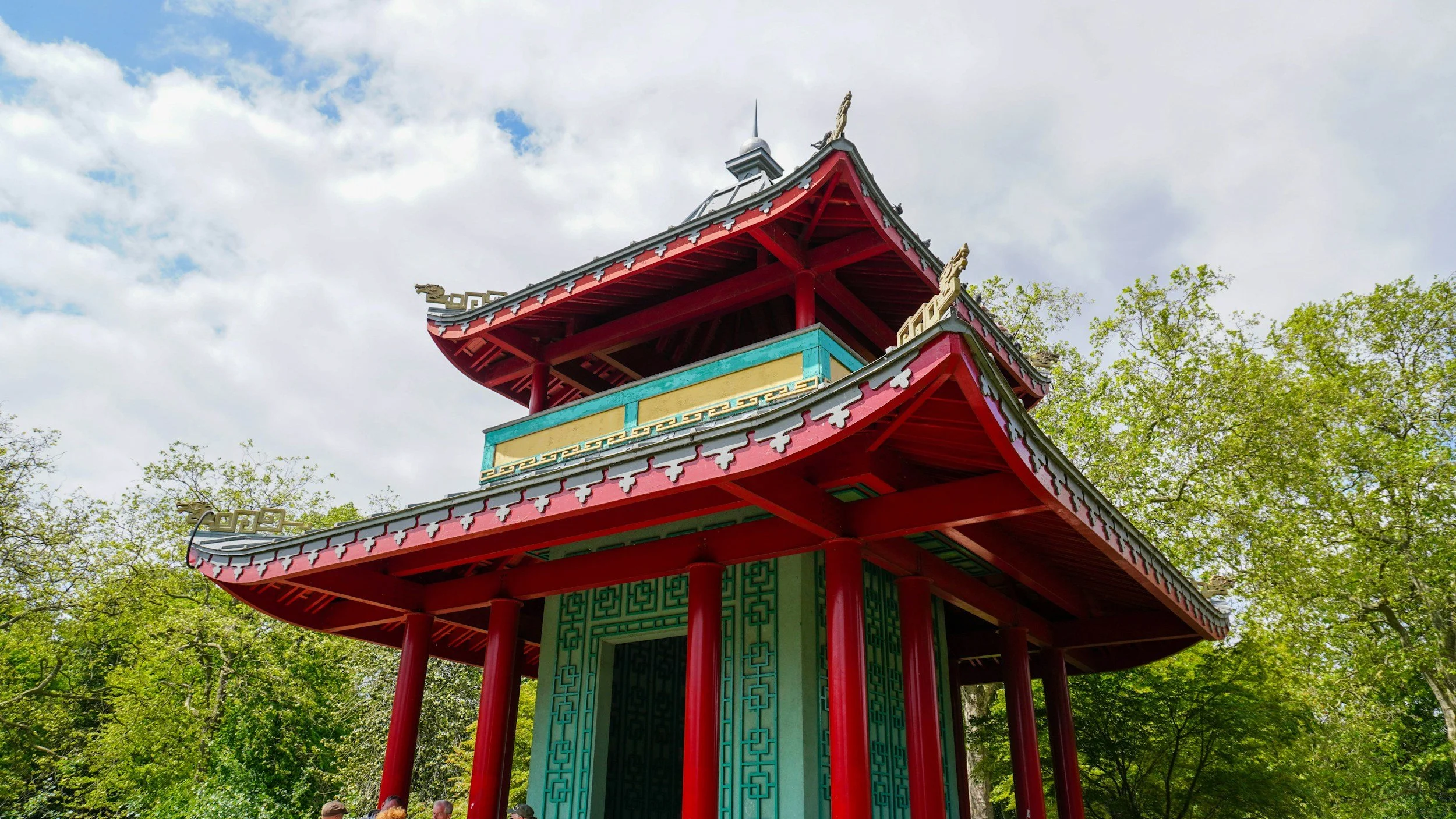
London has a habit of hiding extraordinary things in plain sight.
You can spend years exploring the city and still stumble across something that makes you stop and wonder:
"How have I never noticed this before?"
That's exactly how many people feel when they first come across the Chinese Pagoda in Victoria Park.
Standing quietly beside the lake in East London, its bright red columns and distinctive roof feel almost unexpected. Surrounded by trees, gardens and walking paths, it looks as though it belongs in another world entirely.
And in many ways, it does.
Because this isn't simply a pretty pavilion.
It's a survivor.
Its story stretches back nearly two centuries and involves Hyde Park, Victorian exhibitions, wartime destruction and one of London's most beloved parks.
And despite all that history, many Londoners still walk through Victoria Park without knowing why it's there.
A Piece of Victorian Curiosity
The story begins long before Victoria Park itself became one of East London's favourite green spaces.
In the 1840s, American collector Nathan Dunn organised a Chinese Exhibition in Hyde Park. Victorian Britain had developed a fascination with distant cultures, and Dunn's collection offered Londoners a glimpse into Chinese art, architecture and daily life.
As part of the exhibition, an ornate Chinese-style pagoda was constructed.
When the exhibition ended, the structure found a new home in Victoria Park, which had recently opened to provide much-needed green space for the rapidly growing East End.
Over time, the pagoda became one of the park's most recognisable features.
Generations of Londoners enjoyed boating on the lake while the elegant structure watched quietly from the island nearby.
A Survivor of War
Like much of East London, Victoria Park suffered heavily during the Second World War.
Bombing raids damaged many parts of the park and the Chinese Pagoda was no exception.
Eventually, the original structure disappeared altogether.
For decades, photographs and memories were all that remained.
Visitors who wandered through the park after the war had little reason to suspect that such an unusual landmark had once stood there.
But the story didn't end there.
Bringing the Pagoda Back
In 2010, after years of planning and research, a new Chinese Pagoda was unveiled.
The reconstruction wasn't simply about replacing an old building.
It was about restoring a forgotten piece of Victoria Park's history.
Inspired by historical images and drawings, the modern structure was carefully designed to capture the spirit of the original pavilion that once stood here.
Today, it has become one of the most photogenic spots in the park.
Yet somehow, it still feels surprisingly peaceful.
Unlike many of London's famous landmarks, crowds aren't constantly gathering around it.
People jog past.
Cyclists pass by.
Families feed ducks on the lake.
And the pagoda quietly goes about doing what it has done for generations—adding a little beauty to everyday life.
How to Visit the Chinese Pagoda
Finding it is easier than many people realise.
The pagoda stands on an island in the western lake area of Victoria Park, close to the Crown Gate entrance and not far from the boating area.
Getting There
By Tube
The nearest stations are:
Mile End (Central, District and Hammersmith & City lines)
Bethnal Green (Central line)
Hackney Wick (London Overground)
From any of these stations, it's roughly a 15 to 20-minute walk depending on which entrance you use.
By Bus
Several buses serve Victoria Park and the surrounding area, including routes from Bethnal Green, Hackney and Stratford.
By Bike
Victoria Park is one of the easiest parks to reach by bike, thanks to the many cycling routes running through East London.
Santander Cycles are also available nearby.
What Else Is Worth Seeing Nearby?
One of the best things about visiting the pagoda is that it doesn't have to be the entire trip.
Victoria Park itself is worth exploring.
Stroll Around the Lakes
The lake area is one of the prettiest parts of the park.
Swans, ducks and tree-lined paths make it feel surprisingly peaceful considering you're still in London.
Visit the Old English Garden
A quieter corner filled with seasonal flowers and winding paths.
Many visitors never make it this far.
Stop at Pavilion Café
One of East London's most popular cafés sits right beside the lake.
Grab a coffee and sit outside if the weather is good.
Explore Hackney Wick
Just a short walk away, Hackney Wick has become one of London's most creative neighbourhoods.
Canals, street art, breweries and independent cafés make it a great place to continue the day.
Walk Towards the Queen Elizabeth Olympic Park
If you've got time, continue east and you'll eventually reach the Olympic Park, adding another side of modern London to your day.
Why Places Like This Matter
The Chinese Pagoda isn't Buckingham Palace.
It isn't Tower Bridge.
And it won't appear on most first-time London itineraries.
But perhaps that's exactly why it feels special.
Because London's charm isn't only found in the famous landmarks.
Sometimes it's found in the places you discover unexpectedly.
A red pagoda standing beside a lake.
A quiet corner of East London.
A reminder that history doesn't always announce itself loudly.
Sometimes it simply waits patiently for curious people to find it.
And next time you're wandering through Victoria Park, slow down for a moment.
Look across the water.
You might just spot one of London's most beautiful hidden stories.